Weight Loss Resources
Hundreds of articles about weight loss ...


Reading Food Labels
By Anna Edwards BSc (Hons) ANutr
(1 of 2 pages)
How helpful is labelling for customers?
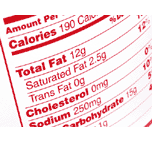 Food labelling is a nutritional information scheme designed by the Food Standards Agency (FSA) that will in theory make it easier for consumer to choose healthier options when shopping.
A growing number of large supermarkets and food manufacturers are using a 'traffic light' labelling system on the front of their food packs. The traffic light scheme tells you how much salt, added sugar and fat is in the food product by marking those particular nutrients as red for high, amber for medium and green for low amounts. The idea is that the consumer can tell at a glance whether a certain product is healthy, and labelling makes it easier to compare the nutritional values of different brands of food.
So do all food retailers use the same labelling system?
Unfortunately not. While food products are required by law to display their nutritional values, there has been conflict between the FSA and large retailers over implementing a uniform labelling system. Sainsbury's, Waitrose and Asda all adhere to the FSA's core principles for front of pack labelling which make use of the traffic light system, but they all design their labels differently. The information on the front of the pack is essentially the same, but consumers may well find one supermarket's design more effective than another's in providing 'at a glance' nutritional information.
Who does it best?
In many ways, this is a matter of personal preference. Compare front of pack labels from Sainsbury's, Asda and Waitrose and there really isn't any difference in the information they provide. All three provide information on salt, sugar, fat and saturated levels per portion of the product, they colour code that information using the traffic light scheme and determine that colour code using FSA guidelines. It is only the layout of that information that varies. Sainsbury's use their 'wheel of health', while Waitrose favours a list. Sainsbury's design seems to be particularly effective as the consumer can instantly see what proportion of the product is high in salts, sugar and fat.
Page 1 | Page 2 |
Disclaimer
You are advised to seek medical advice before making any changes to your diet or lifestyle with an aim of weight loss. This website and the content provided should not be used by persons under 18, by pregnant or nursing women, or individuals with any type of health condition, except under the direct supervision of a qualified medical professional. The information contained in these articles, and elsewhere on this website, is provided for educational and entertainment purposes only, and is not intended to replace, and does not constitute legal, professional, medical or healthcare advice or diagnosis and may not be used for such purposes. Continue...